

How to Reduce Cash on Delivery (COD) Returns in Pakistan: 7 Proven Tactics for E-Commerce (2026 Guide)
How to Reduce Cash on Delivery (COD) Returns in Pakistan: 10 Proven Tactics for E-Commerce (2026-27 Complete Guide)
Every e-commerce entrepreneur and dropshipper in Pakistan knows the bitter feeling: you run winning Meta ads, orders start pouring into your Shopify or WooCommerce store, your packing table is full, and you celebrate. But two weeks later, the courier portal delivers the bad news: 30% to 40% of your parcels are returned to origin (RTO) (یعنی پارسل وصول کیے بغیر واپس آگئے).
In Pakistan, Cash on Delivery (COD) (ڈیلیوری پر ادائیگی) is still the most popular payment method in online shopping, and for many small stores it is the only method customers trust. COD makes it easy for first-time buyers to order, but it also creates almost zero commitment for the customer. When an order returns, you lose your advertising spend, courier charges, packing material, and sometimes you get the product back damaged.
If you want to build a sustainable, profitable online business in 2026-27, cutting your return ratio from 35% down to around 15% is one of the fastest ways to increase your net profit without spending even one extra rupee on ads. In this long, step-by-step guide, we explain 10 practical tactics, real calculations, ready-to-copy WhatsApp scripts, a courier scorecard, a risk-scoring system and a 30-day action plan, all written in simple words for Pakistani sellers.
- What changed in 2026-27 for COD sellers in Pakistan
- Why Pakistani customers reject COD parcels (the real reasons)
- The hidden cost of RTO: full maths with examples
- Tactic 1: WhatsApp and phone order verification (with scripts)
- Tactic 2: Fast dispatch and multi-courier routing
- Tactic 3: Micro advance deposits and prepaid discounts
- Tactic 4: Address validation and the COD blacklist
- Tactic 5: Honest product visuals and clear product pages
- Tactic 6: Automated tracking messages
- Tactic 7: NDR management and re-attempts
- Tactic 8: Customer risk scoring system
- Tactic 9: Fix the traffic quality (ads and product pricing)
- Tactic 10: Handle returned parcels smartly
- Illustrative case study: 35% to 15% RTO
- 8 common mistakes that increase returns
- Your 30-day action plan
- Your 2026-27 COD return reduction checklist
- Easy glossary of e-commerce terms
- Frequently asked questions
The core formula: Never ship unverified orders blindly. Verify the customer's phone number and full address on WhatsApp before dispatch, pick the courier according to city performance, send tracking messages, call the customer the same day a delivery attempt fails, and give small rewards (like a discount) to customers who pay in advance. Track your RTO every week by city, courier and product, because what you do not measure, you cannot fix.
📺 Watch the Complete Video Tutorial
Watch our in-depth video breaking down how local e-commerce stores in Pakistan can reduce COD return rates:
1. What Changed in 2026-27 for COD Sellers in Pakistan
The online selling market in Pakistan is more competitive today than it was two or three years ago. Ad costs are higher, customers have more choices, and courier companies are more careful about which shipments they accept. Here are the trends every seller should understand before using the tactics in this guide.
- Higher ad costs mean returns hurt more. When one purchase costs you Rs. 500 to Rs. 800 in Meta ads, every returned parcel wastes that money. A 10% drop in returns is now worth more than a 10% drop in ad cost.
- Digital wallets and instant bank transfers are normal now. JazzCash, Easypaisa, NayaPay, SadaPay and Raast-based bank transfers (راست کے ذریعے فوری بینک ٹرانسفر) are used by millions of people, so asking for a small advance payment is much easier than before.
- WhatsApp is the main customer channel. Most Pakistani buyers reply faster on WhatsApp than on phone calls or email, so verification on WhatsApp works better than SMS alone.
- Couriers offer better dashboards and APIs. Many courier and fintech-logistics companies now provide tracking links, merchant portals and automatic status updates that you can connect with your store or a Google Sheet.
- Customers are more careful about online scams. After many fake pages appeared, buyers now check reviews, real photos and return policy before ordering. A trustworthy product page gives fewer rejected parcels.
Note: Courier rates, payout timelines and policies change often. Always confirm the latest details with your courier account manager before making business decisions.
2. Why Pakistani Customers Reject COD Parcels (The Real Reasons)
Before fixing returns, you must understand why customers decline parcels when the rider rings the doorbell. In most stores, the reasons fall into two groups: customer-side reasons and seller or courier-side reasons. Many sellers blame only customers, but a big part of the problem is actually in our own process.
Customer-side reasons
- Impulse buying regret: The customer placed an order late at night after watching a TikTok or Instagram reel, but by the time the parcel arrives after 4 or 5 days, the excitement is gone.
- Double ordering: Impatient buyers order the same item from two online pages and accept whichever arrives first.
- Fake or wrong details: Curious browsers or children testing your checkout without real buying intent.
- Cash not ready: The rider arrives without warning and the customer does not have the full amount at home.
- Family disagreement: The buyer ordered without asking parents or spouse, and the family says "return it".
- Price comparison: The customer finds the same product cheaper in a local market while waiting for delivery.
Seller-side and courier-side reasons
- Slow dispatch: The order is booked 3 days after confirmation, so the customer forgets about it.
- Rider did not try properly: Riders sometimes report "customer not answering" or "address incomplete" without visiting the location, especially when they have too many parcels.
- Product does not match the ad: The photo shows a premium-looking item, but the real product looks cheaper.
- Wrong size, colour or item: A packing mistake in your warehouse.
- No communication: The customer received no message before delivery, so the rider's call from an unknown number was ignored.
Ahmed from Faisalabad orders a Rs. 2,500 wireless speaker at 1:00 AM after seeing a Facebook ad. The seller does not confirm the order and the parcel is booked after 3 days. The courier takes another 4 days. On the 7th day, a rider calls from an unknown number and Ahmed does not pick up because he forgot about the order. The rider writes "customer not answering" and the parcel returns. One simple WhatsApp confirmation and a faster dispatch could have saved this order.
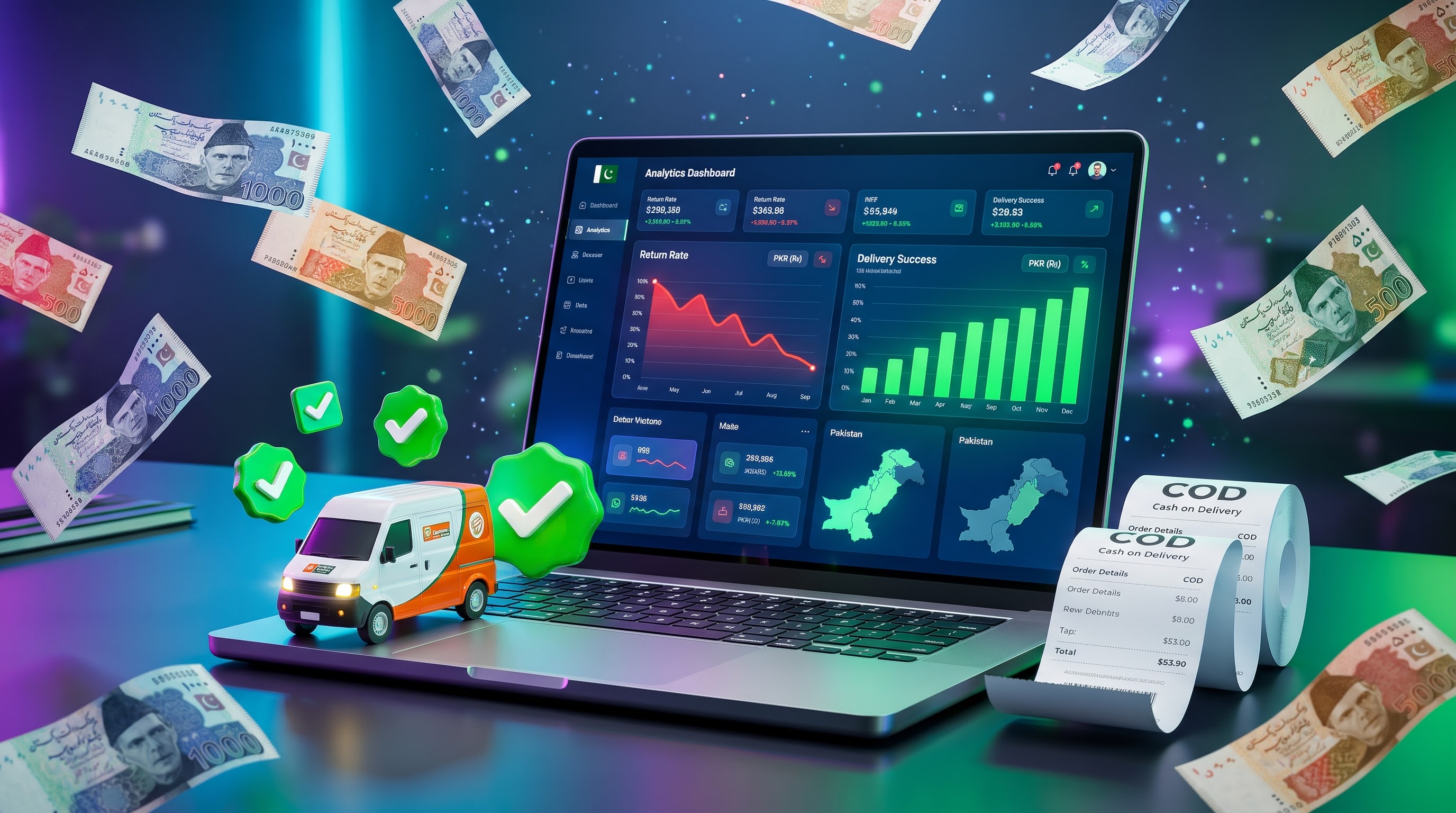
3. The Hidden Cost of RTO: Full Maths With Examples
Many sellers think a returned parcel only means "zero profit". In reality, every return directly takes money out of your pocket. Let us calculate with simple numbers.
Suppose you sell an item for Rs. 2,500. Your product cost is Rs. 1,000, your ad spend to get one order is Rs. 600, delivery charges for a successful parcel are Rs. 250, and for a returned parcel you pay Rs. 350 (delivery plus return charges). Packing material is about Rs. 50.
- Delivered order profit: Rs. 2,500 - (Rs. 1,000 product + Rs. 600 ads + Rs. 250 shipping + Rs. 50 packing) = +Rs. 600 net profit.
- Returned order loss (product comes back safely): Rs. 600 ads + Rs. 350 shipping + Rs. 50 packing = -Rs. 1,000 pure loss.
So one returned parcel wipes out the profit of almost two delivered parcels.
What happens when return rate changes? (per 100 orders)
Using the same numbers above (profit Rs. 600 per delivered parcel and loss Rs. 1,000 per returned parcel), here is what your monthly profit looks like for every 100 orders:
| Return Rate (RTO) | Delivered Parcels | Profit from Delivered | Loss from Returned | Net Profit (per 100 orders) |
|---|---|---|---|---|
| 10% | 90 | Rs. 54,000 | -Rs. 10,000 | Rs. 44,000 |
| 20% | 80 | Rs. 48,000 | -Rs. 20,000 | Rs. 28,000 |
| 30% | 70 | Rs. 42,000 | -Rs. 30,000 | Rs. 12,000 |
| 35% | 65 | Rs. 39,000 | -Rs. 35,000 | Rs. 4,000 |
| 40% | 60 | Rs. 36,000 | -Rs. 40,000 | -Rs. 4,000 (loss) |
Look at the difference: with the same ads, same product and same price, a store with 10% returns earns Rs. 44,000 from 100 orders, while a store with 35% returns earns only Rs. 4,000. That is the power of controlling returns.
Your break-even return rate (simple formula)
Break-even point (وہ نقطہ جہاں نہ نفع ہو نہ نقصان) is the return rate at which your profit becomes zero. You can calculate it like this:
Break-even RTO % = Profit per delivered parcel ÷ (Profit per delivered parcel + Loss per returned parcel) × 100
In our example: 600 ÷ (600 + 1,000) × 100 = 37.5%. If your return rate goes above 37.5%, you are losing money on every 100 orders even if your ads dashboard looks great.
If your COD return rate crosses 30%, you will slowly run out of cash flow even if Meta Ads Manager shows a healthy 3.0x Return on Ad Spend (ROAS) (اشتہار پر خرچ کے مقابلے میں آمدن). ROAS counts placed orders, not delivered orders. Always calculate your delivered ROAS = (revenue from delivered parcels) ÷ (ad spend).
4. Tactic 1: WhatsApp and Phone Order Verification (With Ready Scripts)
The most effective step to remove fake and doubtful orders is a two-step confirmation before you book the parcel with the courier. It costs very little, but it can reduce returns a lot because it filters out impulse buyers and wrong numbers.
Step-by-step process
- Step 1 - Instant WhatsApp message (within 5-15 minutes of order): Use a tool like BotSpace, WATI or a simple WhatsApp Business app with Quick Replies. Send the order summary and ask for confirmation.
- Step 2 - Wait up to 4 hours: If the customer replies "CONFIRM" or "Yes", mark the order as verified and move it to dispatch.
- Step 3 - Phone call for no response: If there is no reply after 4 hours, call the customer for 30 seconds. Confirm the name, product and address.
- Step 4 - Two attempts rule: If the phone is switched off, invalid or not answered after two attempts on different times of the day, put the order on hold for 24 hours and then cancel it.
- Step 5 - Record the result: Write "Verified", "Cancelled by customer" or "No response" in your order sheet. This data helps you build your blacklist later.
Copy-paste WhatsApp scripts
English script:
Roman Urdu script (easy for local customers):
A clothing store in Lahore receives 100 orders in a week. After sending WhatsApp confirmations, 72 customers confirm, 10 cancel by themselves, and 18 do not reply. The store calls the 18 customers and 7 confirm. The store cancels the remaining 11 orders. Instead of shipping 100 parcels, it ships 79 verified parcels. Even if the pre-dispatch cancellations cost the Rs. 600 ad spend each, saving the extra Rs. 400 (shipping and packing) on every unverified parcel that would have been returned adds up quickly.
Never use threatening language like "if you do not accept the parcel we will take legal action". It damages your brand and can bring bad reviews. Use polite, short messages and make it easy for the customer to say yes or no.
5. Tactic 2: Fast Dispatch and Multi-Courier Routing
Delivery speed has a direct effect on COD success. Every extra day a parcel spends before delivery gives the customer more time to change their mind, find a cheaper option or run out of cash. Many experienced sellers observe that return chances grow noticeably with each extra transit day, so the rule is simple: dispatch within 24 hours of verification.
Courier comparison (general overview)
| Courier Service | Best Coverage | Typical Payout Cycle | Notes for COD sellers |
|---|---|---|---|
| TCS | Nationwide, remote areas, high brand trust | Weekly / Bi-weekly | Reliable network, higher base tariffs |
| Leopard Courier | Punjab and major urban cities | Bi-weekly | Fast dispatch, good regional hubs |
| PostEx | E-commerce and dropshipping sellers | Often faster payouts | Tech-friendly dashboard and COD payouts |
| BlueEx / M&P | Karachi and industrial routes | Weekly | Competitive rates for bulk volume |
This table is a general guide. Real performance depends on your city, product size, volume and the local branch. Always test with your own parcels.
How to do multi-courier routing (step-by-step)
- Open an account with at least 2 couriers. Do not depend on only one company, because a strike, delay or bad local branch can stop your business.
- Send 20-30 parcels per city to each courier in the first month as a test.
- Record delivery rate and delivery days for each city and courier in a Google Sheet (see the scorecard below).
- Assign the best courier to each city. For example, Courier A for Lahore, Courier B for Karachi, Courier C for small towns.
- Review every month. Courier performance changes, so keep testing a small share of parcels with other couriers.
Simple courier scorecard (copy into Google Sheets)
| City | Courier | Parcels Sent | Delivered | Returned | Delivery Rate | Avg. Days |
|---|---|---|---|---|---|---|
| Lahore | Courier A | 100 | 86 | 14 | 86% | 2.5 |
| Lahore | Courier B | 100 | 78 | 22 | 78% | 3.5 |
| Small town (example) | Courier C | 40 | 31 | 9 | 77.5% | 5 |
The numbers above are only an example. The point is to compare real data from your own store. If Courier A delivers 86% and Courier B delivers 78% in the same city, then even if Courier A is Rs. 40 more expensive per parcel, it can still give you more profit because fewer parcels return.
Shipping rates eat into your margins. Always compare logistics costs before choosing your courier partner.
- Instantly compare city-wise Cash on Delivery charges using our Free COD Courier Rate Calculator (TCS, Leopard, M&P & BlueEx).
- Scale your operations with our Pakistani E-Commerce & Dropshipping Master Toolkit (Rs. 1,499) — complete with verified wholesale suppliers, return management sheets, and winning ad scripts!
- Fast stores get fewer cancellations: optimize all product pictures with our free browser-based WebP Image Optimizer.
6. Tactic 3: Micro Advance Deposits and Prepaid Discounts
If you sell products priced above Rs. 5,000 (such as electronics, custom apparel or premium leather goods), offering 100% Cash on Delivery is risky. A small advance payment shows that the buyer is serious.
Option A: Micro advance deposit
Ask the buyer to transfer just Rs. 300 to Rs. 500 (ایڈوانس رقم) through JazzCash, Easypaisa, NayaPay or bank transfer to cover delivery fees, and collect the remaining balance on delivery. Genuine customers usually agree, while non-serious buyers filter themselves out.
Option B: Prepaid discount
Offer a small discount (for example 5% or a free gift) for customers who pay in full online before dispatch. This gives you instant cash, removes courier COD handling risk, and the customer is almost certain to accept the parcel.
A Rs. 6,000 smart watch store offers: "Pay Rs. 500 advance and your delivery is free. Or pay full amount online and get a free watch strap."
- Without advance: 100 orders, 30 returns = 30 × Rs. 1,000 loss = Rs. 30,000 wasted.
- With advance: 60 orders come after the rule (fewer fake leads), only 6 return, and every returned order already has Rs. 500 collected to cover shipping.
You may get fewer orders, but your delivered orders and profit per order usually improve. Test the rule on a small group of products first.
Always give the customer a clear receipt, write the refund policy on your website, and use only your real business account details. Many people fear online fraud, so a trusted brand name, real address and customer reviews make advance payments much easier.
7. Tactic 4: Address Validation and the COD Blacklist
Many Pakistani shoppers type vague addresses like "Near Main Bazar, Street 2, Rawalpindi". When the rider arrives, he cannot find the house and marks it as "Address Incomplete".
How to fix addresses at checkout
- Make House/Plot number, Street name, Area/Town, City and Nearest landmark mandatory fields in your Shopify or WooCommerce checkout.
- Ask for a second contact number (a family member or a friend) in case the first one is not answered.
- Ask the customer to send their Google Maps location pin on WhatsApp during verification for difficult areas.
- Use dropdown menus for city names to avoid spelling mistakes that confuse courier systems.
How to build a COD blacklist (step-by-step)
- Create a Google Sheet named COD Blacklist with columns: Phone number, Name, City, Reason, Date.
- Add customers who refused parcels without a valid reason or gave fake details more than once.
- Check every new order's phone number against this sheet before WhatsApp verification.
- For blacklisted numbers, require 100% advance payment or reject the order politely.
Fairness tip: Add a number to the blacklist only after a clear pattern (for example 2 refused parcels). One failed delivery can happen because of courier mistakes, so do not punish a customer unfairly. Keep customer data private and use it only for your own business protection.
8. Tactic 5: Honest Product Visuals and Clear Product Pages
One of the top reasons customers reject a parcel at the door is that the item looks different from the edited advertisement. Customers feel cheated, and they simply say "I do not want it".
What to include on every product page
- Real, unedited smartphone photos and a short unboxing video, alongside your studio graphics.
- Exact size, colour options, material and what is inside the box. For clothes, add a size chart in centimetres or inches.
- Clear delivery time (for example "3 to 5 working days") and a clear return or exchange policy.
- Honest reviews with real customer photos when available.
- Your business address, WhatsApp number and a business name customers can trust.
A kitchen gadget seller used only glossy AI-style images and got many "not as expected" returns. After adding a 15-second real video showing the actual size of the product next to a hand and a tea cup, customers understood the real size before ordering. Fewer people ordered by mistake, and refusals at the door dropped.
If you use Canva for your creatives, keep typography clean and avoid exaggerated claims. Check our 500+ E-Commerce Canva Templates Suite (Rs. 999) to design realistic, high-converting product creatives.
9. Tactic 6: Automated Tracking Messages
Keep the buyer informed at every step of the shipping journey so they stay interested and keep cash ready. Most failed deliveries happen because the customer was not expecting the rider.
Recommended message sequence
- Order confirmed: "Your order is confirmed and will be dispatched within 24 hours."
- Dispatch day: "Dear [Name], your order has been booked via [Courier], tracking #[Number]. Expected arrival in 2-3 working days."
- Out for delivery day: "Dear [Name], your parcel will be delivered today by the rider. Please keep Rs. [Amount] cash ready and keep your phone available."
- Delivered: "Thank you for shopping with us. Please share your feedback on WhatsApp."
"Assalam-o-Alaikum [Name], aap ka parcel aaj deliver hoga. Meharbani kar ke Rs. [Amount] cash tayyar rakhein aur apna phone kholla rakhein. Shukriya."
10. Tactic 7: NDR Management and Re-Attempts
NDR stands for Non-Delivery Report (جب رائڈر پارسل ڈیلیور نہ کر سکے اور پورٹل پر رپورٹ درج کرے). Most sellers leave NDR tickets to the courier company, which often means the parcel is returned after the final attempt.
Daily NDR routine (step-by-step)
- 4:00 PM daily: One support member opens the courier dashboard and exports all parcels with a failed attempt today.
- Within 3 hours: Call or WhatsApp every customer. Ask politely: "Our rider tried to reach you today. When can we deliver tomorrow?"
- Update the courier: Send the corrected address, new phone number or preferred time through the courier portal or account manager.
- Escalate if needed: If the rider repeatedly says "customer not answering" but the customer says nobody called, tell your courier representative and request a fresh attempt with a different rider.
- Close the loop: Record the final result (delivered, returned, cancelled) in your sheet.
Common NDR reasons and the best response
| NDR Reason | What to do |
|---|---|
| Customer not answering | Message and call from your business number; ask for a convenient time; request re-attempt |
| Address incomplete / wrong | Get the exact address and Google Maps pin; update the courier |
| Customer refused | Ask politely for the reason; offer exchange or discount if the issue is fixable |
| Cash not available | Offer a re-attempt tomorrow or payment through a wallet/bank transfer |
| Area not reachable / closed | Ask the customer for an alternative delivery point such as a nearby shop or office |
11. Tactic 8: Customer Risk Scoring System
Not every order has the same risk. You can give every order a simple score (خطرے کا اسکور) and treat high-risk orders differently. This can be done in a Google Sheet without any expensive software.
| Signal | Risk Points |
|---|---|
| Order placed between 12 AM and 5 AM | +1 |
| Incomplete address (no house number or landmark) | +2 |
| No WhatsApp response after 4 hours | +2 |
| Phone number found on blacklist | +5 |
| First-time customer with high-value order (above Rs. 5,000) | +2 |
| Remote or low-delivery-rate area (based on your own data) | +2 |
| Returning customer with 2 or more successful deliveries | -3 |
| Customer paid advance | -4 |
What to do with the score
- Score 0 or below (low risk): Dispatch normally after verification.
- Score 1 to 3 (medium risk): Verify by phone call and confirm the full address before dispatch.
- Score 4 or above (high risk): Ask for advance payment, or politely cancel the order.
These point values are a starting example. After 2 to 3 months of your own data, adjust the points to match what really happens in your store.
12. Tactic 9: Fix the Traffic Quality (Ads and Product Pricing)
Sometimes the problem starts before the order: the wrong audience and the wrong promise bring low-quality orders. Here is how to improve it.
- Do not oversell in ad copy. Phrases like "limited stock, order now or lose it" can create panic buying, and panic buyers often regret later. Use honest benefit-focused copy.
- Show the price clearly. If the ad says "Rs. 999" but the checkout adds Rs. 300 delivery, many customers refuse. Mention delivery charges early.
- Check return rate by campaign. Add UTM tags or a campaign name in your order sheet. One ad set may bring 10% returns while another brings 45%. Stop spending on the bad one even if its cost per order looks cheap.
- Use lead forms carefully. Instant lead forms are quick but usually bring more fake or casual leads than website checkout with address fields.
- Retarget previous buyers. Customers who successfully received parcels before have much lower return risk. Create a custom audience of past buyers for repeat offers.
Two ad sets sell the same product. Ad Set 1 has a cost per order of Rs. 450 but 42% returns. Ad Set 2 has a cost per order of Rs. 650 but only 14% returns. Looking only at ad cost, Ad Set 1 looks better. After counting returns, Ad Set 2 gives far more cost per delivered order. Always compare cost per delivered parcel, not cost per placed order.
13. Tactic 10: Handle Returned Parcels Smartly
Even the best stores cannot reach 0% returns. What you do after a return decides whether you lose Rs. 1,000 or save part of it.
- Inspect every returned parcel on the day it arrives. Take a photo or short video while opening it, so you have proof if the courier damaged it.
- Claim courier damage or loss in writing within the courier's claim window. Ask your account manager about the exact deadline.
- Restock good items quickly. Clean, repack and add them back to inventory so the stock is not forgotten.
- Call the customer for feedback (politely) when the refusal reason is unclear. These calls reveal problems in price, quality or delivery speed.
- Keep a return reason column in your sheet: changed mind, price issue, wrong address, did not receive call, product looked different, etc. After one month, fix the top 2 reasons first.
14. Illustrative Case Study: Reducing Returns From 35% to 15%
This is an illustrative example built with simple numbers to show how the tactics work together. It is not the result of one specific named store, and your own results will depend on your product, city mix and audience.
Imagine a store that sells home accessories at Rs. 2,500 per item, receives 300 orders per month, and uses the same economics as our earlier example (Rs. 600 profit per delivered parcel and Rs. 1,000 loss per returned parcel).
| Metric | Before (no system) | After (with tactics) |
|---|---|---|
| Monthly orders | 300 | 300 |
| Return rate | 35% | 15% |
| Delivered parcels | 195 | 255 |
| Returned parcels | 105 | 45 |
| Profit from delivered parcels | Rs. 117,000 | Rs. 153,000 |
| Loss from returned parcels | -Rs. 105,000 | -Rs. 45,000 |
| Net monthly profit | Rs. 12,000 | Rs. 108,000 |
Same orders, same ads, same product. The only change is a better process: WhatsApp verification, faster dispatch, city-wise courier selection, tracking messages, NDR follow-up and a blacklist. The profit difference in this example is Rs. 96,000 per month. Even if your real result is only half of this, it is still a big improvement.
15. Eight Common Mistakes That Increase Returns
- Dispatching without verification because "we are busy".
- Using only one courier for all cities without checking performance.
- Delaying dispatch for 3 to 4 days because of stock or packing issues.
- Ignoring NDR updates and discovering the return only when the parcel is back.
- Judging ads only by ROAS and ignoring delivered ROAS.
- Hiding delivery charges until the final step.
- Using over-edited product images that create the wrong expectation.
- Not recording data. Without a sheet that tracks city, courier, product and return reason, you cannot know what to fix.
16. Your 30-Day Action Plan
| Week | What to do | Result you want |
|---|---|---|
| Week 1 | Create your order tracking sheet (city, courier, product, ad campaign, status, return reason). Calculate your current return rate and break-even rate. | Know your real numbers |
| Week 2 | Start WhatsApp verification with the scripts in this guide. Make address and landmark fields mandatory. Create the blacklist sheet. | Fewer fake and unconfirmed orders |
| Week 3 | Open a second courier account and test parcels city-wise. Start dispatch within 24 hours. Add dispatch and out-for-delivery messages. | Faster delivery, better courier choice |
| Week 4 | Start the daily 4 PM NDR routine. Test an advance payment or prepaid discount on high-value products. Review return reasons and fix the top two. | Return rate moving toward 15% |
17. Your 2026-27 COD Return Reduction Checklist
| Stage | Action Item | Goal |
|---|---|---|
| Product Page | Real photos, clear size/colour, delivery time and return policy | Remove expectation mismatch |
| Checkout | Require landmark, second number and WhatsApp number | Zero fake contact details |
| Pre-Dispatch | Verify via WhatsApp or phone within 4 hours; check blacklist and risk score | Cancel unconfirmed leads early |
| Fulfillment | Dispatch within 24 hours using the best courier for that city | Beat buyer remorse |
| In-Transit | Send tracking message and "Out for Delivery" reminder | Ensure cash and phone availability |
| Failed Attempt | Follow up within 3 hours of courier NDR update | Convert failed deliveries into completed sales |
| After Return | Inspect, claim damage, restock, record the return reason | Reduce losses and learn |
| Weekly Review | Check RTO by city, courier, product and ad campaign | Keep improving with data |
18. Easy Glossary of E-Commerce Terms
| Term | Easy meaning |
|---|---|
| COD | Cash on Delivery (ڈیلیوری پر ادائیگی) - customer pays when the parcel arrives |
| RTO | Return to Origin (پارسل واپس بھیجنے والے کے پاس آ جانا) |
| NDR | Non-Delivery Report (ڈیلیوری نہ ہونے کی رپورٹ) |
| ROAS | Return on Ad Spend (اشتہار کے خرچ پر آمدن) |
| Dispatch | Handing the parcel to the courier (پارسل روانہ کرنا) |
| Blacklist | List of risky numbers you avoid or restrict (ناپسندیدہ گاہکوں کی فہرست) |
| Break-even | The point where profit is zero (نہ نفع نہ نقصان) |
| Advance deposit | Small payment made before dispatch (پیشگی رقم) |
19. Frequently Asked Questions
What is a good COD return rate for e-commerce in Pakistan?
There is no single official number because it depends on product type, price and city. Many beginner stores see around 25% to 35% returns. Stores with active WhatsApp verification and NDR follow-up often bring this down to roughly 10% to 15%. Track your own number weekly and aim to improve it step by step.
Can couriers in Pakistan open parcels before payment?
Generally, couriers do not allow "Open Parcel on Delivery" unless you have an explicit open-box service with them. Check your courier's current policy and clearly mention it on your website to avoid conflicts between riders and customers.
Should I stop offering Cash on Delivery completely?
For most small stores, no. Many Pakistani buyers still prefer COD and removing it can reduce your orders heavily. The better formula is COD with strict pre-dispatch verification, plus a small discount or free gift for prepaid wallet or bank payments.
Which courier service has the lowest return rate in Pakistan?
No single courier is best in every city. Performance changes by city, branch, parcel size and season. Test at least two couriers in each major city and keep a scorecard, as explained in Tactic 2.
How long should I wait for WhatsApp confirmation?
A good rule is 4 hours during the day. If the order comes at night, wait until the next morning before calling. If there is no reply after two call attempts, hold for 24 hours and then cancel.
Is it legal to keep a list of customers who refused parcels?
Keeping a private record of your own orders and delivery results for internal business protection is common practice. Do not publish customers' personal data publicly or share it carelessly. If you are unsure, ask a qualified lawyer or consultant. This article is not legal advice.
What should I do if the rider says the customer refused but the customer says nobody came?
Contact your courier account manager immediately with the tracking number, the customer's statement and the time of the call. Ask for the rider's call record or a fresh attempt. Keep a written record of such cases and use them when negotiating with the courier or deciding whether to change courier for that city.
Does a lower price reduce returns?
Not always. Very cheap products can attract careless buyers. What reduces returns is a clear promise, honest visuals, fast delivery and good communication. Test your pricing carefully and compare cost per delivered order.
Key takeaways
- One returned parcel can erase the profit of two successful parcels, so returns are a profit problem, not a small inconvenience.
- Verify every order on WhatsApp or by phone before dispatch.
- Dispatch within 24 hours and choose couriers by city performance.
- Use small advance payments or prepaid discounts for higher-value products.
- Follow up on every failed delivery the same day.
- Measure delivered ROAS and RTO by city, courier, product and campaign every week.
Final Word: E-commerce success in Pakistan is not just about getting cheap clicks on Meta Ads; it is about converting deliveries into cash in your bank account. Start with one tactic this week, usually WhatsApp verification, then add the others step by step and watch your net margins grow.
Need more tools to run your digital agency or store? Explore our Free Digital Utilities Suite to edit PDFs, manage image compression, and simplify shipping calculations.
Disclaimer: Courier tariffs, return processing rules, and payment gateways change frequently in Pakistan. All figures, percentages and case studies in this guide are simplified examples for learning and are not guaranteed results. Always check current terms directly with your designated courier representative. This guide is for educational purposes only and is not legal or financial advice.


